

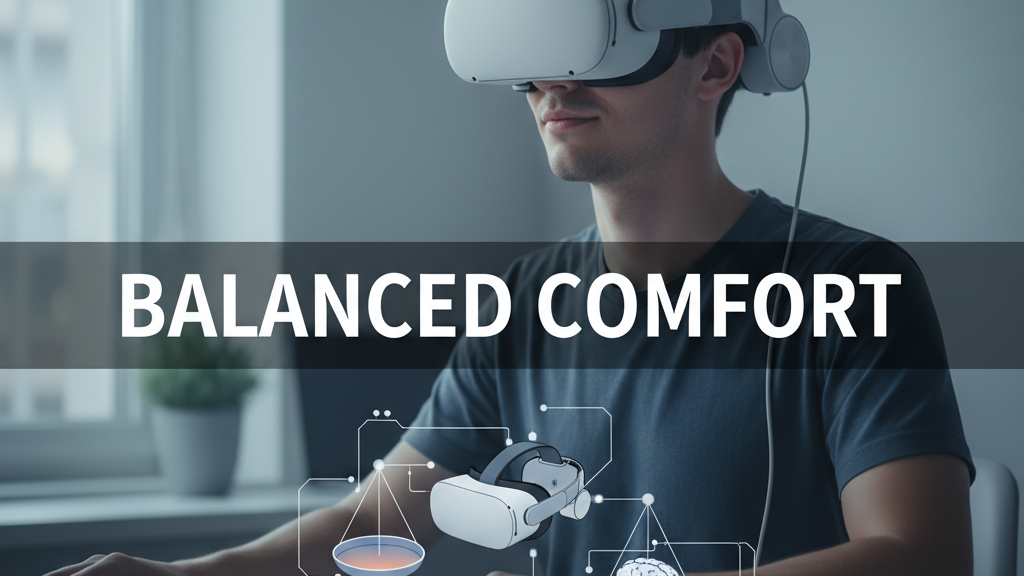
Using Back-Weight Counterweights to Balance Heavier VR Headsets Without Sacrificing Mobility
If you love long VR sessions but end them with a sore neck or a tired forehead, a rear-mounted counterweight can restore natural balance and comfort. This guide explains how back-weight counterweights work, how to choose and install them on a Quest 2 (and similar headsets), and how to fine-tune fit so you keep full mobility while reducing fatigue. ⏱️ 5-min read
Why weight distribution drives long-session comfort
Most consumer headsets concentrate mass at the front—lenses, displays, and electronics—so the headset pulls forward and your neck must constantly counteract that torque. Over time that front-heavy bias causes neck strain, pressure on the nasal bridge, and early fatigue during extended play.
Adding a small back-weight shifts the headset’s center of gravity rearward, letting the head sit in a more neutral posture. Instead of fighting a forward pull, muscles hold the headset naturally; the result is less soreness and more endurance for long sessions—without needing a bulky strap that limits head rotation.
How counterweights work: balance, leverage, and mobility
The physics is straightforward: torque equals force times distance. A counterweight positioned behind the head creates an opposing moment that cancels the front-heavy moment from the headset. The key is placement and leverage—weights placed farther back require less mass to achieve the same balancing effect.
Properly designed counterweights maintain mobility because they don’t lock the headset into a rigid halo; they simply rebalance it. As long as the weight sits low on the occipital area and doesn’t interfere with inside-out tracking cameras or straps, rotational freedom and tracking integrity remain intact.
Choosing counterweights: weight ranges, placement, and compatibility
Start small and iterate—every head and headset is different. As a baseline:
- Start with 100–150 g (total) of rear weight for a Quest 2-style headset; some users prefer 150–200 g if they have heavier faceplates, glasses, or an attached battery pack.
- If you’re using a power bank as both weight and battery, consider its mass and location; many battery solutions fall between 120–250 g.
- Don’t exceed roughly 250–300 g on the back unless you’re sure your neck can handle it—too much rear weight defeats the purpose and can cause new pressure points.
Compatibility notes:
- Stock Quest 2 straps: many counterweight modules clip or Velcro to the rear of the fabric strap; ensure the attachment method matches your strap model.
- Aftermarket straps (halo-style, Elite strap, etc.): verify mounting points—some require dedicated counterweight mounts or replacement rear plates.
- Vision Pro and other premium headsets: check manufacturer guidance before adding mass; adapter accessories may be required and Apple’s ecosystem has specific accessory compatibility rules.
Step-by-step install for Quest 2 and common headsets
These universal steps apply to most back-weight modules. Read your product manual first—mounting hardware varies.
- Turn off your headset and remove any fragile accessories. Loosen or detach the existing strap so you can access the rear harness.
- Position the counterweight module so it sits behind the occipital bone—roughly the lower rear of the skull—where it provides the best leverage without riding too low on the neck.
- Attach by the designed method (clip, screw, Velcro, or strap-through plate). If using Velcro or straps, thread cleanly so the weight can’t slide during movement.
- Route any cables (power or passthrough) along the strap, keeping them flat and out of the tracking cameras’ view. Secure with small Velcro ties or cable clips.
- Re-seat the headset, tighten the top and side straps, and check for glasses clearance and pressure points.
Fine-tuning fit for comfort and mobility
Fine-tuning is where comfort becomes personal. Use these checks and adjustments:
- Adjust strap height so the display sits level—too low or high changes how the weight feels.
- Slide the counterweight slightly up or down along the rear plate: higher gives more rotational control; lower increases leverage but may contact neck skin.
- Test with quick head turns and natural movements: the headset should remain stable without tugging or slippage. Make small weight changes—add or remove 25–50 g increments.
- Wear for a short play interval (20–30 minutes) and reassess. Some pressure points only show up after extended use.
Performance in real use: mobility, battery packs, and heat
A well-placed counterweight minimally affects mobility. Inside-out tracking systems like Quest 2 rely on unobstructed camera views; keep the rear mass low and centered so it doesn’t block sensors or cause reflective surfaces to confuse tracking.
Battery packs are a common dual-purpose solution—providing extra runtime and the necessary rear mass. When using a battery pack:
- Mount it low and centered on the rear plate to preserve balance.
- Use a short, flexible USB-C cable routed along the strap. Secure connectors to avoid yanking sensors during head motion.
- Monitor heat: some battery packs can run warm. Ensure the pack doesn’t press uncomfortably into skin and remove it if you notice excessive heating.
Expect slightly more inertia when making very rapid head movements, but properly balanced setups rarely limit the natural range of motion for gaming or simulation use.
Care, safety, and maintenance plus alternatives
Routine checks prevent failures and discomfort:
- Inspect attachment points and fasteners before each session. Tighten screws and replace worn Velcro or straps.
- Wipe down pads and straps with a mild disinfectant and allow to dry. Avoid soaking electronic battery modules.
- Store the headset with the weight removed if you won’t use it for weeks—this preserves strap elasticity.
Alternatives to back-weights:
- Upgraded halo-style or ergonomic straps that redistribute front weight to a larger contact area—these may reduce the need for extra mass.
- Lightweight headsets or modular faceplates that reduce front-end weight entirely.
- Hybrid solutions: small counterweights plus upgraded padding for a balanced, low-profile setup.
Each approach has trade-offs: halo straps can add bulk, and lighter headsets mean replacing hardware. Counterweights are usually the quickest, reversible, and cost-effective fix for Quest 2 owners who want more comfort without sacrificing mobility.
Closing tips
Start light, place weight behind the occiput, and iterate in small increments. For Quest 2 and similar headsets, 100–150 g is a practical starting point. Check compatibility with your strap type and any headset-specific accessories like Vision Pro adapters before buying. With careful placement and routine checks, a back-weight counterweight can restore natural posture, cut fatigue, and keep your movement free for long VR sessions.
Powered by Trafficontent


Share:
GraviPro setup guide: integrating gravity-assisted gear with Meta Quest and Valve Index
Fog-Free and Cool: Anti-Fog Solutions and Thermal Management for Comfortable VR