

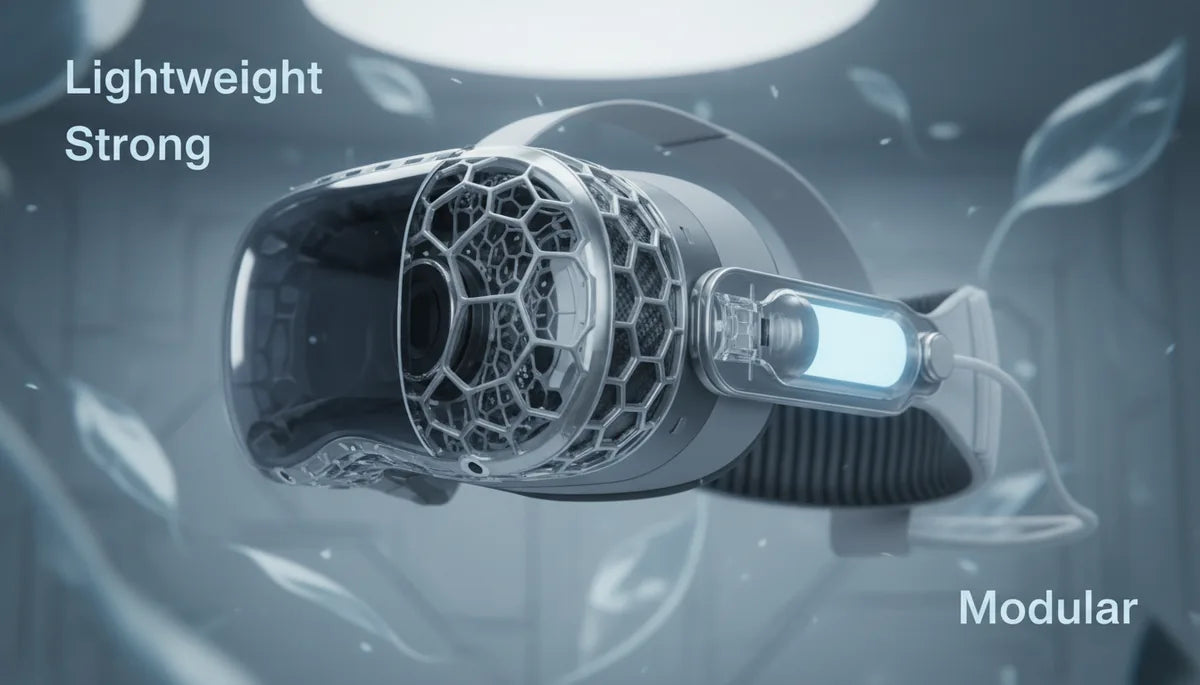
Design and Material Choices That Cut VR Headset Weight Without Sacrificing Durability
Reducing a VR headset’s mass while keeping it tough is a systems-level problem: the right materials, smart geometry, careful electronics integration, and rigorous testing all matter. This guide walks VR product designers, hardware engineers, and serious enthusiasts through practical choices—materials, structural strategies, and manufacturing techniques—that shave grams without compromising safety, comfort, or longevity. ⏱️ 9-min read
Lightweight frame materials and structural optimization
Choosing the frame material is the first and most impactful lever for reducing weight-distribution-and-back-support" rel="nofollow noopener noreferrer">VR headset weight. Common contenders are magnesium alloys, aluminum, and carbon fiber reinforced polymers (CFRP). Magnesium alloy has a density near 1.74 g/cm³ and offers excellent specific strength for stamped or die-cast frames; aluminum (≈2.70 g/cm³) is ubiquitous, forgiving in machining and recycling, and cheaper; CFRP can achieve densities around 1.4–1.6 g/cm³ with very high specific stiffness when properly laid up. For stiff, thin structures that must resist bending and torsion—critical to keep optics aligned—CFRP and magnesium often outperform aluminum on a stiffness-to-weight basis, though integration cost and tooling must be considered.
Beyond raw material choice, geometry is where you turn material performance into real weight savings. Hollow sections, ribbed frames, and wall-thinning unlock mass reduction with minimal stiffness loss. For thermoformed or injection-molded parts, target wall thicknesses in the 1.0–1.8 mm range where permissible; in metal die-cast frames, use ribbing and gussets to replace thicker walls. Additive manufacturing enables lattice infills and topology-optimized geometries that concentrate material where stress is highest and remove it where it’s not needed—typical lattice fill fractions of 10–30% retain rigidity while cutting bulk.
Design for targeted stiffness—identify critical load paths (optic mounts, strap anchors, and Interface to PCB boards) and keep those solid while aggressively reducing mass elsewhere. Use FEA early and iterate with realistic load cases: bending under a 1–2 kg equivalent head load, torque from head movements, and mounting shock loads. Quantify gains: swapping a conventional 2.7 g/cm³ aluminum subframe for a CFRP subframe of equivalent stiffness can often save 20–40% of the subframe mass. Always validate with physical prototypes because joint stiffness, assembly tolerances, and fastening schemes can negate theoretical gains if not managed.
Shell design and impact-durable lightweight skins
The outer shell protects internal components and defines the user experience, but it also contributes significantly to overall mass. Polycarbonate (PC) and PC/ABS blends are industry standards because they combine impact resistance, surface finish, and cost-effectiveness; PC density is roughly 1.2 g/cm³. For higher stiffness or heat resistance, glass-filled nylons (densities up to 1.3–1.5 g/cm³) can be used where a bit more rigidity is needed, but be mindful that glass fill increases brittleness and can add mass. For premium, lightweight shells, thin CFRP skins over a lightweight core provide exceptional bending stiffness at low weight.
Sandwich constructions give a powerful combination of lightness and impact resistance. A thin, stiff outer skin (PC or CFRP) bonded to a low-density core (honeycomb, foam, or Nomex-style cores) multiplies bending stiffness without the mass penalty of a thick solid shell. For example, a 0.8–1.2 mm PC outer shell over a 3–6 mm micro-honeycomb core can reduce shell weight by 30–50% compared to a 3–4 mm solid shell while maintaining drop- and crush-resistance needed in consumer environments.
For impact-durable lightweight skins, minimalism in protective features helps. Slim ribbing, integrated bumper zones, and sacrificial lip geometries can absorb impact energy without resorting to thick walls or heavy padding. Keep internal protective partitions only where necessary—around optics and PCBs—and use locally reinforced bosses for fasteners. When padding is required, use thin closed-cell foams or engineered lattice cushions that provide energy absorption with far less mass than traditional thick foam pads. These strategies keep exterior form and durability high while trimming grams.
Internal layout and weight distribution for balance
Perceived weight is as important as actual mass. A headset that places heavy modules close to the head’s center reduces torque on the neck and feels lighter during use. The classic approach is to push heavier subsystems—battery packs, processing modules, or heatsinks—slightly posterior toward the crown or back strap so the resulting center of gravity (CG) sits closer to the head’s pivot point. Even modest rear bias often makes the headset feel substantially lighter in long sessions; design teams report subjective comfort improvements of 20–40% after moving 50–100 g rearward, thanks to reduced front torque and better pressure distribution.
Modular trays and standardized fasteners simplify assembly and reduce redundant structural supports that add weight. Design removable submodules (battery, sensor module, speaker module) constrained by a few well-placed datum points and a single locking mechanism. This minimizes the number of bosses or secondary support features and allows you to optimize each tray for minimal mass. Additionally, use thin form-factor backplates and stiffened ribs on trays instead of full solid plates—topology optimization can lower tray mass by 30–60% versus solid designs.
Don’t neglect cable routing and airflow channels: bulky cable bundles add both mass and perceived clutter. Route flexible flat cables (FFC) or thin coax in defined channels to avoid redundant protective sheaths. In headsets with active cooling, integrate air paths into the structural geometry rather than adding ducting. These integration-focused choices keep internal volume lean, reduce the need for thick shells or extra brackets, and improve the overall equilibrium of the headset during head movement.
Strap systems and contact surface optimization
Strap systems and face interfaces are the most tactile parts of a headset; they have outsized influence on comfort and the feeling of weight. Replace heavy metal buckles and adjusters with high-strength polymer components and low-mass mechanical adjusters. Materials like Dyneema and high-tenacity polyester offer excellent tensile strength at a fraction of the mass of metal webbing hardware. Consider low-profile BOA-style dials with polymer gears or polymer-over-molded cam systems for fine adjustment without heavy metal parts.
Cushioning strategy affects both comfort and weight. Traditional thick memory-foam face pads weigh more and retain heat; engineered open-cell foams and 3D-printed lattice cushions can deliver comparable pressure distribution at 30–60% lower mass. Target foam densities between 25–50 kg/m³ for face contact zones, and keep thickness minimal—3–8 mm for low-profile systems—while relying on contoured geometries to distribute pressure. For brow and top-of-head contact, thin breathable pads or tension-distributing pads with a larger surface area beat thicker pads that concentrate load.
Optimizing strap geometry also reduces hardware weight. Distribute loads through multiple attachment points to allow thinner anchor bosses and smaller fasteners. Use polymer snap-fit anchors or captive nylon inserts to avoid steel screws where possible. When metal is necessary, swap stainless steel screws for titanium or aluminum where strength allows; titanium fasteners offer ~40% lower density than steel with excellent strength, which is beneficial when many small fasteners add up.
Battery and electronics integration strategies
Battery choice and placement are major contributors to headset mass. Lithium-ion pouch cells and prismatic cells typically provide higher volumetric efficiency and lower mass than cylindrical cells for the same capacity. Current state-of-the-art pouch cells deliver around 200–300 Wh/kg depending on chemistry; choosing higher-energy-density cells lets you reduce battery mass for the same runtime. For systems that can tolerate external power, consider detachable or belt-mounted battery packs that shift mass entirely off the head. A 150–250 g battery moved to a belt can dramatically improve comfort without reducing session time.
Cable routing and interconnect design also present weight-saving opportunities. Replace bulky multi-core harnesses with thin flexible printed circuits (FPC) or micro-coax bundles where signal integrity allows. Reducing copper thickness from standard 35 µm to 18 µm on internal FPCs saves grams and still supports many VR signal bandwidths if impedance and thermal constraints are managed. Likewise, replacing rigid PCBs with thin polyimide substrates in non-structural zones reduces board mass and permits folding or conformal mounting to shrink enclosure volume.
Electronics packaging must prioritize mechanical support for optics and sensors while minimizing redundant enclosures. Use integrated heat spreaders and common backplates shared between boards to eliminate duplicate plate mass. Where heat dissipation is necessary, explore lightweight vapor chambers or thin graphite sheets instead of heavy aluminum heatsinks. For swappable modules, consider using pogo-pin interconnects and precision mechanical guides to reduce the need for bulky board-mounting hardware and over-engineered enclosures.
Manufacturing methods and joinery for light yet durable builds
Additive manufacturing (AM) offers design freedom to optimize internal structures for weight and strength. SLS, MJF, and SLA processes enable lattice infills, topology-optimized junctions, and internal channels that would be impossible with traditional tooling. For mid-volume production, you can prototype lattice-supported internal brackets and then translate those geometries into injection-molded rib patterns that retain much of the mass benefit. Typical results: a lattice bracket built in SLS can be 40–70% lighter than the same part made solid, while still meeting stiffness targets.
For large runs, injection molding with engineered ribs, gussets, and cores is the most cost-effective route. Structural foaming techniques and co-injection molding allow you to create skins with integrated low-density cores, saving mass without adding assembly steps. CFRP layups are appropriate when the per-unit cost justifies the performance; use unidirectional tapes or quasi-isotropic layups only where loads require them and design joints to distribute peel stresses, which CFRP dislikes.
Joinery decisions matter: favor structural adhesives and plastic welds over over-specified mechanical fasteners to reduce mass and keep part counts low. Structural epoxies and acrylic adhesives bond dissimilar substrates and allow for thinner overlapping joints compared to bolt-and-bracket assemblies. Where fasteners are unavoidable, choose high-strength low-mass materials (titanium or aluminum) and use captive inserts sized to minimize boss diameter. Ultrasonic welding or vibration welding for thermoplastic parts eliminates screws entirely in many locations and improves crash performance by creating continuous load paths.
Durability validation and real-world testing
Testing must validate that weight reductions do not come at the expense of durability. Build a test matrix that includes drop and impact tests (drops from 0.5–1.5 m onto concrete and mixed surfaces), thermal cycling (-20°C to 60°C), vibration profiles (e.g., IEC 60068 or MIL



Share:
How to Pick a Quest 2 Comfort Strap Based on Weight Distribution and Back Support
How to Fit Oculus Quest 2 with Glasses Without Pinching or Slipping