

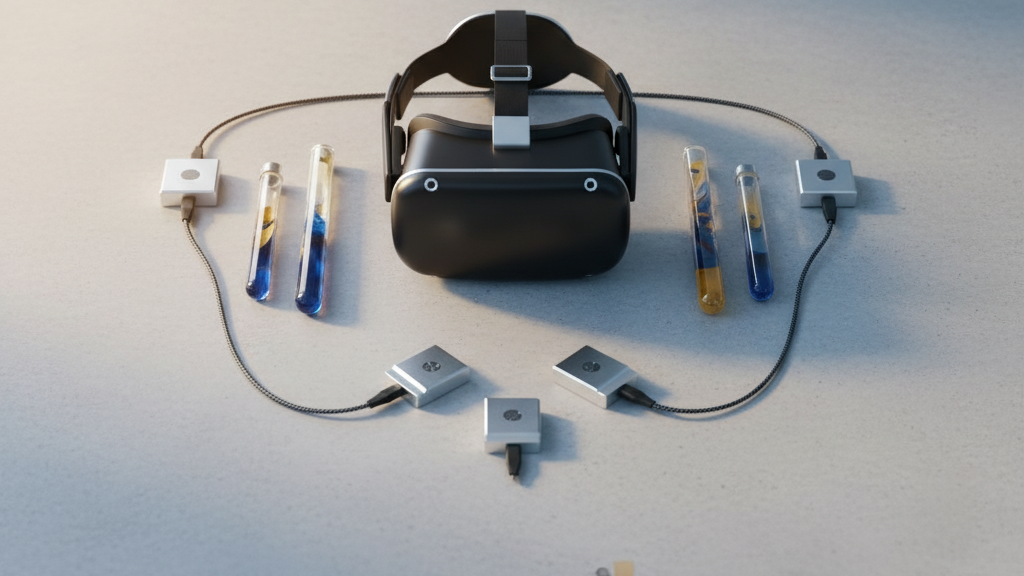
Measuring Ergonomic Impact: A Metric-Driven Guide to Comfort and Posture with GraviPro and Flit Lift VR Wearables
Designing or evaluating VR wearables—whether you’re embedding GraviPro assistive vectors or pairing a headset with Flit Lift support—demands more than subjective impressions. Teams need a reproducible set of physical and perceptual metrics that translate sensor streams into design decisions: improved balance, lower neck load, longer comfortable sessions. This guide lays out the metrics, measurement methods, and data practices to quantify how GraviPro and flit-lift-weightless-vr-comfort/maximizing-vr-endurance-battery-life-and-efficiency-with-gravipro-tech" rel="nofollow noopener noreferrer">Flit Lift change the real-world experience of wearing a headset. ⏱️ 10-min read
Targeted at hardware designers, UX researchers, integrators, and informed gamers, the following sections combine practical instrumentation advice, threshold suggestions, and examples of analysis workflows you can adopt today. Read it as a checklist for experiments and an operational blueprint for embedding ergonomic feedback into product development.
Defining Ergonomic Metrics for VR Wearables
Start by grouping metrics into five actionable buckets: static, dynamic, posture, physiological, and subjective. Static metrics capture sustained loads and contact pressures—what the neck and shoulders endure when the user holds a pose. Dynamic metrics quantify how movement quality (velocity, acceleration, repetition) affects joint stress and perceived effort. Posture metrics describe alignment—neck flexion, head pitch, spine curvature—while physiological signals (HRV, skin conductance, EMG) make fatigue visible. Subjective metrics close the loop with user-rated comfort and usability.
GraviPro devices commonly expose IMUs, load cells, and haptic streams. IMUs on the head, torso and hips provide orientation, angular velocity and linear acceleration to compute joint angles and movement quality. Load cells measure strap and harness forces at contact points; haptic timing helps associate interaction intensity with pressure spikes. A metric engine fuses these streams—for example, combining strap load with head pitch to compute neck torque—and produces both live cues and post-session analytics.
Set clear benchmark types from the outset: instantaneous thresholds (e.g., neck torque not to exceed X Nm), sustained exposures (e.g., >20° neck flexion for more than 60 seconds), and relative improvements (e.g., 30% reduction in perceived load with Flit Lift engaged). These anchors keep experiments comparable across users and device generations.
Static Weight and Balance Measurements
Quantifying static balance begins with pressure mapping and load-cell instrumentation at the headset contact points, torso harness, hip belt, and feet. For an accurate snapshot, capture a neutral stance with eyes forward for 60–90 seconds while logging strap loads, pressure zones and ground reaction proxies. Convert raw force readings into a distribution map—percent of total supported weight on torso vs. hips vs. feet—and display them as a heatmap and a center-of-gravity (CoG) marker on a footprint diagram.
Key deliverables from a static test: strap load in Newtons, headset pitch in degrees, CoG projection relative to the base of support, and hotspot pressure indices (peak pressure divided by mean pressure). A practical baseline is to expect the CoG projection to remain within the central 40% of the base width during neutral stance; repeated lateral drift beyond that range suggests misdistributed load or harness misfit. For headset torque, establish a working threshold—target a sustained neck torque under 0.5 N·m during neutral posture, but validate this against user reports and EMG in your cohort.
When comparing configurations—headset alone, headset + GraviPro, headset + Flit Lift—use paired within-subject tests. Report absolute values and relative change (for example, GraviPro reduced anterior strap load by 18% and shifted CoG posteriorly by 12 mm). These static measures are simple but powerful: they indicate whether assistive hardware is re-routing load off the neck and toward stronger body regions (hips/torso), which directly correlates with comfort over longer sessions.
Dynamic Lifting Metrics: Weight Reduction in Action
Static numbers are only half the story. Dynamic tasks—reaching, looking up, quick head turns—reveal how support systems react when loads and moments change. Instrument hands, forearms and the headset with load cells and IMUs to capture lift forces, hand velocity, acceleration, and grip engagement through task cycles. The goal: quantify how GraviPro or Flit Lift change the felt load during motion and how quickly support engages.
Primary dynamic metrics to capture: peak lift force (N), time-to-assist (ms) from movement onset to assist engagement, percent reduction in instantaneous torque (Nm), and stability of assist (variance in assist force during motion). For responsive support, aim for assist latency under 100 ms—ideally 50–80 ms—so users perceive the reduction as continuous rather than jerky. Measure lift response stability by tracking force variance; lower variance indicates smoother assistance and fewer disruptive micro-corrections.
Translate these numbers into user-centric outputs: perceived load reduction (an algorithmic estimate of how much easier a reach felt, shown as a percentage), and task performance metrics (faster placement times, fewer slips). In a prototype assembly scenario, for instance, GraviPro might reduce peak wrist moment by 22% and decrease mean time-to-place by 12%, while Flit Lift could reduce forward-head torque spikes during repeated upward glances by 30% with sub-80 ms assist latency. Report both objective and perceived improvements side by side to make ergonomic benefits tangible for product and UX stakeholders.
Posture and Motion Analytics in VR Sessions
Robust posture analytics fuse IMU streams located on the head, sternum, and pelvis (and optionally wrists) into a world-aligned coordinate frame. Compute joint angles—neck flexion, head pitch, thoracic kyphosis and pelvic tilt—and normalize them to a standard reference posture. Metricize motion quality through smoothness (low variance in velocity), jerk (rate of change of acceleration), path efficiency (actual path length / optimal path), and repetition counts for micro-movements that predict overuse.
Actionable posture thresholds help translate continuous telemetry into UX decisions. Examples: flag neck flexion angles exceeding 20° sustained for more than 60 seconds as a “postural fatigue” risk; warn when head tilt exceeds 30° during more than 30% of a 15-minute session. Use normalized jerk to detect abrupt starts/stops—sharp jerk spikes often precede discomfort and indicate assistance tuning is required.
Present results in two forms. First, in-session dashboards: a live posture health indicator (green/amber/red), compact tilt and rotation readouts, and a “stability score” that blends variance in CoG and head pose. Second, post-session reports with time-series plots, heatmaps of frequent head orientations, and metrics such as mean posture variance and repetition density. Compare baseline and assisted conditions to show whether GraviPro or Flit Lift reduce pathological postures and improve motion efficiency over time.
Physiological Indicators of Comfort and Fatigue
Objective biosignals make subjective fatigue measurable. Integrate EMG on the upper trapezius and sternocleidomastoid to estimate muscle effort; capture heart rate and inter-beat intervals (for HRV), and sample skin conductance and skin temperature to index arousal and local heating—both relevant to perceived discomfort. Use baselines: establish each user’s resting HRV and a brief MVC (maximum voluntary contraction) for EMG normalization when practical.
Useful thresholds and rules of thumb: flag sustained EMG above 20% MVC for longer than 30 seconds as a potential discomfort zone; detect HRV (RMSSD) drops of greater than 10% from baseline as an early physiological sign of increasing strain; note skin conductance rises over 0.5 µS in short windows as a correlate of heightened arousal or discomfort. These thresholds are starting points—calibrate them to your population.
Correlate physiological changes with sensor and subjective events. For example, if neck torque spikes coincide with EMG increases and a drop in HRV across several minutes, that cluster reliably signals meaningful fatigue. Use multivariate models (e.g., a logistic regression or a simple decision tree) to predict a comfort breach and drive interventions: suggest a break, auto-adjust harness tension, or modify in-game elements that require prolonged up-gaze. Physiological indicators allow you to move from reactive fixes to proactive ergonomics.
Subjective Comfort and Usability Scales
Objective sensors need subjective calibration. Implement repeated, short subjective probes and standard instruments to map experience onto numbers designers understand. Include a 0–10 Comfort Rating Scale sampled every 4–6 minutes and after major posture changes; pair it with adapted versions of the System Usability Scale (SUS) focused on weight, balance, and control clarity, and use NASA-TLX to capture mental and physical workload for demanding tasks.
Operationalize thresholds for intervention. For example, set comfort warnings when a user’s rolling average drops below 6/10, or when SUS-equivalent scores for “weight distribution” and “balance” fall under a benchmark (SUS-equivalent under 68). Use time-aligned mapping: tie each subjective rating to the sensor state at that moment, allowing you to build predictive models that map strain signatures to comfort drops. This is particularly useful when tuning assistive algorithms—if small strap adjustments consistently translate to +1 point on the comfort scale, you have actionable ROI data.
Collect subjective data consistently across tasks and user demographics. Include questions about fit, pressure points, and perceived assistance responsiveness. When combined with objective streams, subjective scores become validators: they show whether measured improvements (reduced torque, improved CoG) translate into real-world comfort gains for diverse users.
Data Protocols and Benchmarking Framework
Consistency is the backbone of meaningful comparison. Standardize sensor schemas and sampling rates: IMUs at 60–120 Hz, load cells at 100–200 Hz, EMG at 1000 Hz (with appropriate filtering), and physiological markers (HR, GSR) sampled at 1–4 Hz or at event-driven resolution. Export data in timestamped JSON or CSV (ISO 8601 UTC timestamps) with fields like sensor_id, axis values, and quality flags; always log the actual sampling rate for each stream.
Define a compact benchmark suite of reference tasks to run in the same order and environment: 1) neutral posture hold (60–90 s), 2) single-handed reach cycle (10–15 reps), and 3) fatigue hold (two-minute upward gaze or sustained neck flexion). For each task, capture posture deviation, peak angles, assist latency, and a composite comfort index combining EMG, HRV and subjective ratings. Run within-subjects across three sessions and three users as a minimum reproducibility check.
Follow strict data governance: informed consent, de-identification (opaque user IDs), and minimal retention periods. Annotate datasets with calibration state and environmental notes (room temp, headset model), so confounds are traceable. Store processed KPI tables and raw streams separately; this expedites dashboards while preserving the raw material for deeper analysis.
Developer Guidance and Practical Implications
Turn metrics into product improvements by shaping data flows and UX affordances. For API design, offer WebSocket streams for posture and assist telemetry and REST endpoints for session summaries. Normalize units on ingest, debounce sensor spikes, and provide clear event semantics (e.g., assist_on, assist_off, calibration_needed). Implement backpressure handling in streams and keep in‑frame calculations light—aim for live feedback latency below 40 ms and dashboard refreshes at 5–15 Hz.
Calibration routines matter: run automated first-launch calibration (quiet, tall, centered pose) and allow manual re-calibration. Provide a visible status badge that shows calibration health, and an in-app “fit check” that maps strap load balance and head pitch to a single score. In UI, convert technical KPIs into three simple zones (green/amber/red) and supply corrective actions: “loosen rear strap”, “tighten hip belt”, or “take 2-minute break”.
For teams building with GraviPro and Flit Lift, log configurations with each session—firmware versions, assist gains, and latency numbers—and include them in release notes. Small changes in assist timing have outsized ergonomic effects; track them. A starter integration plan: subscribe to key streams, implement a rolling comfort index, display in-app tips when thresholds cross, and run a two-week pilot with automated reports to iterate on assist tuning and harness design.
Next step: run a short pilot using the benchmark suite, collect both objective streams and repeated comfort ratings, and iterate on assist latency and harness fit until you see consistent reduction in neck torque and EMG along with upward shifts in the Comfort Rating Scale.

Share:
Maximizing VR endurance: battery life and efficiency with GraviPro tech
Maximizing Comfort and Tracking with Flit Lift Accessories